

Poet · Playwright · Scholar · Teacher · Freedom fighter
A Life Lived in the Key of Struggle and Story
1942—2023
Mĩcere Gĩthae Mũgo spent eight decades insisting that knowledge belongs to the people who make it. Her road ran from a village in colonial Kirinyaga to stages and lecture halls in Kampala, Nairobi, Harare and the United States, through exile and a life rebuilt on three continents. Wherever she landed, she made a home and opened it to others.
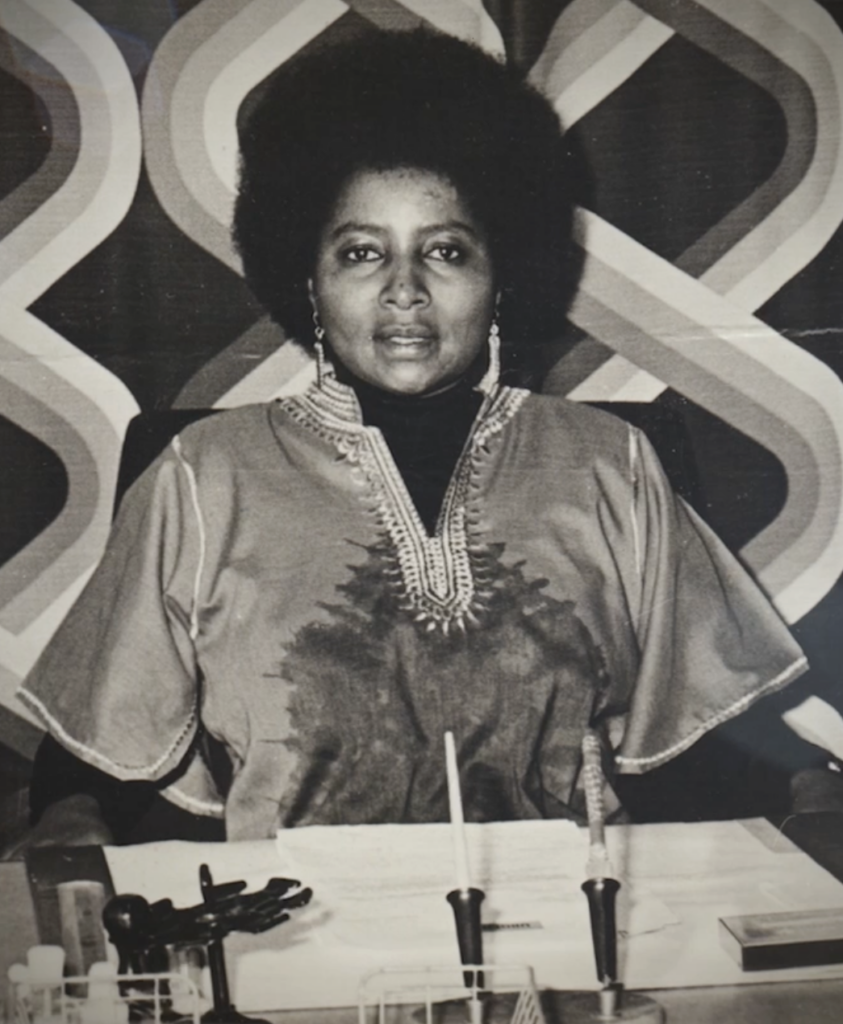
A life that refused to be contained
Poet, playwright, scholar, teacher and organizer, Mĩcere Gĩthae Mũgo belonged to many places at once, and to the people’s struggles in each of them.
Her life moved through Kirinyaga and Kampala, Fredericton and Nairobi, Lagos and Canton, Harare and Lesotho, Mozambique and Dakar, Ithaca and Syracuse. Wherever she lived, she took up the community around her as her own: the liberation movements of southern Africa, the Black freedom struggle in the Americas, men in New York prisons who wanted to learn, African women making new lives in the diaspora, young people looking for their voice. Her mother had told her to build new homes wherever she found herself. She did, and she opened each of them to others.
The same convictions ran through everything she made. As a poet she wrote in the rhythms of the songs she grew up with. As a playwright she returned those whom history had silenced to the stage as heroes. As a scholar she argued that Africa’s oral traditions, which she called orature, were not relics but a living body of knowledge. As a teacher she treated every classroom, from a university seminar to a prison, as a place where people could think their way to liberation, and she held that knowledge belongs to the people who make it.
Those convictions cost her dearly. In 1982 she was forced into exile with her daughters and later stripped of her citizenship. She carried on teaching, writing, performing and organizing for four more decades, and left behind a body of work, and a community of students and comrades, that continues to grow.
From Kirinyaga to the world
Open each chapter to read the story of that period, the milestones within it and her own words.
IKirinyaga: a childhood under Emergency1942 – 1956
Madeleine Mĩcere Gĩthae was born on 12 December 1942 in Baricho, in Kenya’s Kirinyaga district, the third of ten children of Senior Chief Richard Karuga Gĩthae and Mwalimu Grace Njeri Gĩthae. Both parents were teachers, and both were active in the long struggle against colonial rule. The world into which she was born was itself at war, with a Second World War abroad and colonial expansion and the resistance to it at home.
When she was ten, in 1952, the colonial government declared a State of Emergency against the Kenya Land and Freedom Army, the movement the British called “Mau Mau”. She entered Embu Girls’ School in the heart of the conflict zone. What she saw there, the violence of the colonial state and the courage of those who resisted it, became the ground of her political conscience and, two decades later, of her most famous play.
IIThe schoolgirl poet and the colonial experiment1957 – 1962
At Alliance Girls’ High School she wrote and publicly recited her first significant poem, a tribute to her dormitory, Burns House. It was written in the high Elizabethan style the colonial syllabus prized, with no trace of the songs and stories she had loved at home. She would later describe that poem as the beginning of a long struggle to reclaim her own creative voice. By her final year, 1960, she was Head Girl, with school prizes in English, literature and drama.
In 1961 she was chosen as one of two students, one African and one Asian, admitted to the all-white Limuru Girls’ High School. The colonial authorities meant the arrangement as a test of whether Black students could match their white peers. She finished at the top of her class and won a scholarship to Oxford.
IIIUhuru: freedom and its unfinished promise1963
On 12 December 1963 the Republic of Kenya came into being. The same day, Mĩcere Gĩthae turned twenty-one. The coincidence stayed with her. She had watched the war for land and freedom as a child, and she now stood at the threshold of adult life as her country crossed its own.
She would spend the rest of her life asking what freedom was for, and for whom. Her answer never stopped at one nation’s borders. Independence, as she came to see it, was the beginning of a struggle rather than its end: against new forms of domination at home, and in solidarity with peoples still fighting colonial and racial rule across Africa and the diaspora. The independent state would later harass her and drive her into exile. Her commitment to the freedom the fighters of the 1950s had imagined outlasted it.
IVMakerere: finding orature1963 – 1966
To the surprise of many, she turned down Oxford and went instead to Makerere University College in Kampala, then the intellectual heart of East Africa. She studied under the poet Okot p’Bitek and the philosopher John Mbiti, among others, and encountered a new field of study, orature, the art and knowledge carried in Africa’s oral traditions. It would shape everything she later wrote.
Makerere also made her a public voice. She won the best national actress award at the Uganda Drama Festival, her poems were broadcast by the BBC, and she became the first woman to edit Penpoint, the English Department’s literary magazine, where she published her first short story and her first play.
VFredericton: the Black Atlantic opens1966 – 1973
Her diploma in education at the University of Nairobi, she later recalled, “had a progressive vision meant to produce teachers who would decolonize education”, an idea close to Paulo Freire’s pedagogy of the oppressed. She completed it in 1967 with a special achievement prize as a student-teacher, and put it straight into practice: as Deputy Headmistress of Alliance Girls’ High School, her old school, and from 1968 as Headmistress of Kabare Girls’ High School, while still in her mid-twenties. In 1969 a Commonwealth Scholarship took her to the University of New Brunswick in Canada.
There she discovered African American and Caribbean writing and the Black Arts Movement, and began to connect the struggles of Black people in the Americas with the liberation wars in Namibia, Angola, Mozambique, Zimbabwe and South Africa. She won the university’s Sir Charles G. D. Roberts Prize for her story “Zawadi”, wrote the play that became The Long Illness of Ex-Chief Kiti, and in 1973 completed a doctorate in literature, recorded as the first held by an East African.
VINairobi: the writer in society1973 – 1982
Back at the University of Nairobi she taught and trained a generation of students and lecturers. As the first Chief Examiner of English and Literature for the East African Examinations Council, she helped Africanize what children across the region read and were tested on, and she trained the examiners who marked them. She broadcast special features on the Voice of Kenya and sat on the jury of the Noma Award for Publishing in Africa.
In 1976 she published three books: The Long Illness of Ex-Chief Kiti; her first collection of poems, Daughter of My People, Sing!; and, with Ngũgĩ wa Thiong’o, The Trial of Dedan Kimathi. The play put the executed Field Marshal Dedan Kimathi on stage not as a terrorist, as colonial records had cast him, but as a hero of the people. She produced Ex-Chief Kiti for the university’s Free Travelling Theatre, and in 1977 played the Woman in the Kenya National Drama production of Kimathi, taking the troupe to FESTAC ’77 in Lagos, the largest Pan-African festival ever held.
In 1978 she published her doctoral study, Visions of Africa. The next year a USAID research award took her to the United States to record conversations with Angela Davis, Gwendolyn Brooks, Haki and Safisha Madhubuti and James Turner. In 1980 she became Dean of the Faculty of Arts, the first woman to hold the post, and began leading a team that recorded the testimony of women who had fought in the war for land and freedom, work the political climate forced her to suspend in 1982. In 1981 she was co-guest of honor with James Baldwin at the PEN International Congress in Amsterdam. At home, the new government of Daniel arap Moi was growing hostile to her and her radical colleagues.
VIIExile: building new homes1982 – 1992
After the attempted coup of August 1982, the harassment of dissenting academics became a crackdown. Mĩcere was smuggled out of Kenya with her two daughters, then seven and five. The Kenyan state stripped her of her citizenship. Her father died in her first year of exile; on the telephone her mother told her: “You who have chosen the path of people’s struggles must find the courage to build new homes and begin new lives wherever you are.”
She did. At St. Lawrence University in Canton, New York, she volunteered to teach Kiswahili, African history and creative writing at the Ogdensburg Correctional Facility, where inmates and staff named her Volunteer of the Year. She crossed the United States speaking about repression in Kenya and testified in Washington.
In 1984 she moved to the University of Zimbabwe, in a country that would later offer her citizenship. Seconded to the Ministry of Education’s Curriculum Development Unit, she led the project that produced eight progressive readers for Zimbabwean schools, among them Chimurenga and Zamani and Sifiso, and later headed the university’s English and Literature unit. She made community theater, performed for Julius Nyerere and Nelson Mandela, examined for universities in seven African countries, and judged the Commonwealth Prize for Literature for the Africa region. Rethinking literature for its audiences, and supported by a Ford Foundation research award, she wrote African Orature and Human Rights (1991), the monograph at the center of her thought. She later reflected on these years in the essay “Exile and Creativity: A Prolonged Writer’s Block” (1997).
VIIISyracuse: liberated zones1992 – 2015
In 1992 she came to Cornell University’s Africana Studies and Research Center as a visiting professor, intending to settle her daughters in college and return to Harare. A health scare kept her in the United States, and in 1993 she joined Syracuse University’s Department of African American Studies, after submitting a distinctive pedagogical proposal that made academic debate a structural method of teaching and learning. It was a method she believed in deeply: ideas, she said, should be allowed “to argue; to debate; to converse”. She stayed twenty-two years, rising to Full Professor in 1997, and regained her Kenyan citizenship in the mid-1990s.
Syracuse became the place where she built what she called liberated zones: classrooms, organizations and gatherings where African knowledge stood at the center rather than the margins. She co-founded the Pan African Community of Central New York in 1994 and the United Women of Africa Organization in 2003. In 2004 she was named to the Laura J. and L. Douglas Meredith Professorship for Teaching Excellence, one of Syracuse University’s most prestigious honors for teaching, becoming the first Black faculty member to hold it. From 2005 to 2008 she chaired the Department of African American Studies, having earlier directed its graduate program and the university’s Africa Initiative, through which she brought Wole Soyinka, Olara Otunnu and others to Syracuse.
Her public voice grew with her years. In 1992 she briefed the U.S. Senate subcommittee on Africa on Kenya’s struggle for change. She chaired the board of the SAPES Trust in Harare, served on the scientific panel of CODESRIA in Dakar, and in Syracuse sat on the boards of Vera House and InterFaith Works. She answered a prominent historian’s complaint about “ghettoizing” African history, helped shape Kenya’s draft constitution, delivered the Mwalimu Julius Nyerere Distinguished Lecture in Dar es Salaam, addressed the United Nations Commission on the Status of Women, and in 2013 was named an Elder of the Order of the Burning Spear (EBS), one of Kenya’s highest national honors, conferred by the President for distinguished service to the nation.
IXElder: the unfinished work2015 – 2023
She retired as Professor Emerita in 2015, honored by a three-day international conference, The Tireless Pursuit. Retirement meant more writing. She co-edited a volume on Chinua Achebe, and in 2021 her keynote for the fiftieth anniversary of Cornell’s Africana Studies and Research Center became The Imperative of Utu / Ubuntu in Africana Scholarship, a short manifesto arguing that scholarship can either enslave or liberate.
Honors came from Nairobi, London and beyond, among them an honorary doctorate from the University of Nairobi and lifetime achievement awards from the Royal African Society and Kenya’s human rights defenders. She lived with multiple myeloma for many years and kept working. In January 2023 she stood on Kenyan soil one last time to accept a human rights award.
Mĩcere Gĩthae Mũgo died in Syracuse on 30 June 2023, at the age of eighty. The city proclaimed 29 July 2023 Mĩcere Gĩthae Mũgo Day.
XAfter: a legacy in motion2023 –
In 2024 the University of South Africa awarded her a posthumous doctorate, and the African Literature Association its Fonlon-Nichols Award for excellence in creative writing and the struggle for freedom of expression. The same year, the Mĩcere Gĩthae Mũgo Foundation was established to carry her work forward.
In 2026, fifty years after The Trial of Dedan Kimathi, The Long Illness of Ex-Chief Kiti and Daughter of My People, Sing! first appeared, the Foundation brought orature into Syracuse’s Clinton Square with the inaugural The Day of Orature. Her voice, recorded and set to music, opened a day of young people’s storytelling, song and spoken word.
Our research, scholarship, and search for knowledge, should take us to as many sites of knowledge as possible, even if this means moving outside our own comfort zones.
— Mĩcere Gĩthae Mũgo
Five ideas she lived by
Across poetry, drama, scholarship and teaching, the same convictions return. Each is a thread the Foundation now carries.
The oral tradition is alive
Orature, a term that emerged at Makerere in her student years, names the art and knowledge carried in song, story, proverb and performance. For Mĩcere it was not folklore to be collected but a living, changing practice, one that “bring[s] us closest to the heart of African people’s self-expression”. In African Orature and Human Rights she showed how oral compositions among the Agĩkũyũ can both protect and violate human rights, and read reality as layered, like an onion. She first set out this “onion structure” theory in Harare in 1989 and at Columbia University in 1992, and carried it into orature-based community theater.
Where to read it
- African Orature and Human Rights (1991)
- Daughter of My People, Sing! (1976)
- My Mother’s Poem and Other Songs (1994)
- “Orature-based Community Theatre” (1999)
- “Lessons from African Orature” (1999)
To be human is to recognize others’ humanity
Utu, the Kiswahili word for humanity, was for her a foundational principle of African ethical thought, tied to human and people’s rights, cultural integrity and collective well-being. In her last book she argued that scholarship can either “colonize, alienate, and enslave” or “raise consciousness, humanize, and liberate”, and that utu should decide which. The idea runs through her criticism long before that book, as in her 2014 tribute to Chinua Achebe’s utu and creative genius.
Where to read it
- The Imperative of Utu / Ubuntu in Africana Scholarship (2021)
- “Celebrating Achebe’s Utu and Creative Genius” (2014)
- The Philosophy of Utu
Making room to think freely
She described Black Studies, and any space where African knowledge stands at the center, as a “liberated zone” inside institutions not built for it. Art and language, she argued in her Nyerere lecture, are “indispensable aspects of culture” in creating such zones, in territories and in minds. In a 2001 keynote for the Ford Foundation in Nairobi she urged African universities to bury the kasuku, or parrot, syndrome and to construct “inventive sites of knowledge”, the idea behind the Foundation’s own call for new sites of knowledge.
Where to read it
- Art, Artists and the Flowering of Pan-Africana Liberated Zones (2013)
- Writing and Speaking from the Heart of My Mind (2011)
- “Burying the Kasuku Syndrome” (2004)
Returning the silenced to the record
From Dedan Kimathi on stage in 1976 to her study of Field Marshal Muthoni wa Kirima in 2004, she worked to restore those whom colonial and post-colonial history had erased, especially women combatants whose stories were silenced or rewritten. As early as 1980 she led a team recording the testimony of women Mau Mau fighters, until repression forced the work to stop.
Where to read it
- The Trial of Dedan Kimathi (1976)
- Muthoni wa Kirima, Mau Mau Woman Field Marshal (2004)
- Interviews with women Mau Mau fighters, 1980–82 (being sought for the Archives)
The classroom as a site of freedom
She shaped what East African students were examined on, edited readers for Zimbabwe’s schools, taught in prisons, and spent twenty-two years at Syracuse. Her rule was plain speech: “We badly need to converse.” Knowledge, she insisted, should be produced with communities, not merely about them. She carried the argument into curriculum work, from “Introducing African Orature Across the Curriculum” to a World Bank address on teaching in local languages.
Where to see it
- Zimbabwe Schools Readers Series (project leader and editor)
- Teaching awards at Syracuse University
Her published works
A complete, citable record of what Mĩcere Gĩthae Mũgo wrote, edited and performed is one of the first commitments of the Mĩcere Gĩthae Mũgo Archives. This is its first edition. Each entry shows its sources and how fully it has been verified.
She published many more book chapters, articles and interviews. They will be added as they are confirmed. If you hold a copy of a work not listed here, please write to us.
Keep, voice, carry
The Foundation that bears her name carries her work forward in three ways.
Keep
The Mĩcere Gĩthae Mũgo Archives preserves her voice, writings, papers and the testimony of those who knew her, and opens them to the public.
Visit the Archives →Voice
The Annual Lecture, The Day of Orature, the Prize for Orature and the Pan-African Dialogues return her work to public life through performance, conversation, and verbal inspiration.
The Annual Lecture & Critical Conversations Series →The Prize for Orature →Carry
The Mĩcere Gĩthae Mũgo Fellowship prepares new and seasoned scholars, story-makers, artists, creatives and activists to take their work further.
The Fellowship →How this biography was written
This account draws on the Foundation’s records and family testimony, checked against published sources. Where sources differ, we follow the family’s record and note the difference in the bibliography. If you can add to this account, please write to us.