

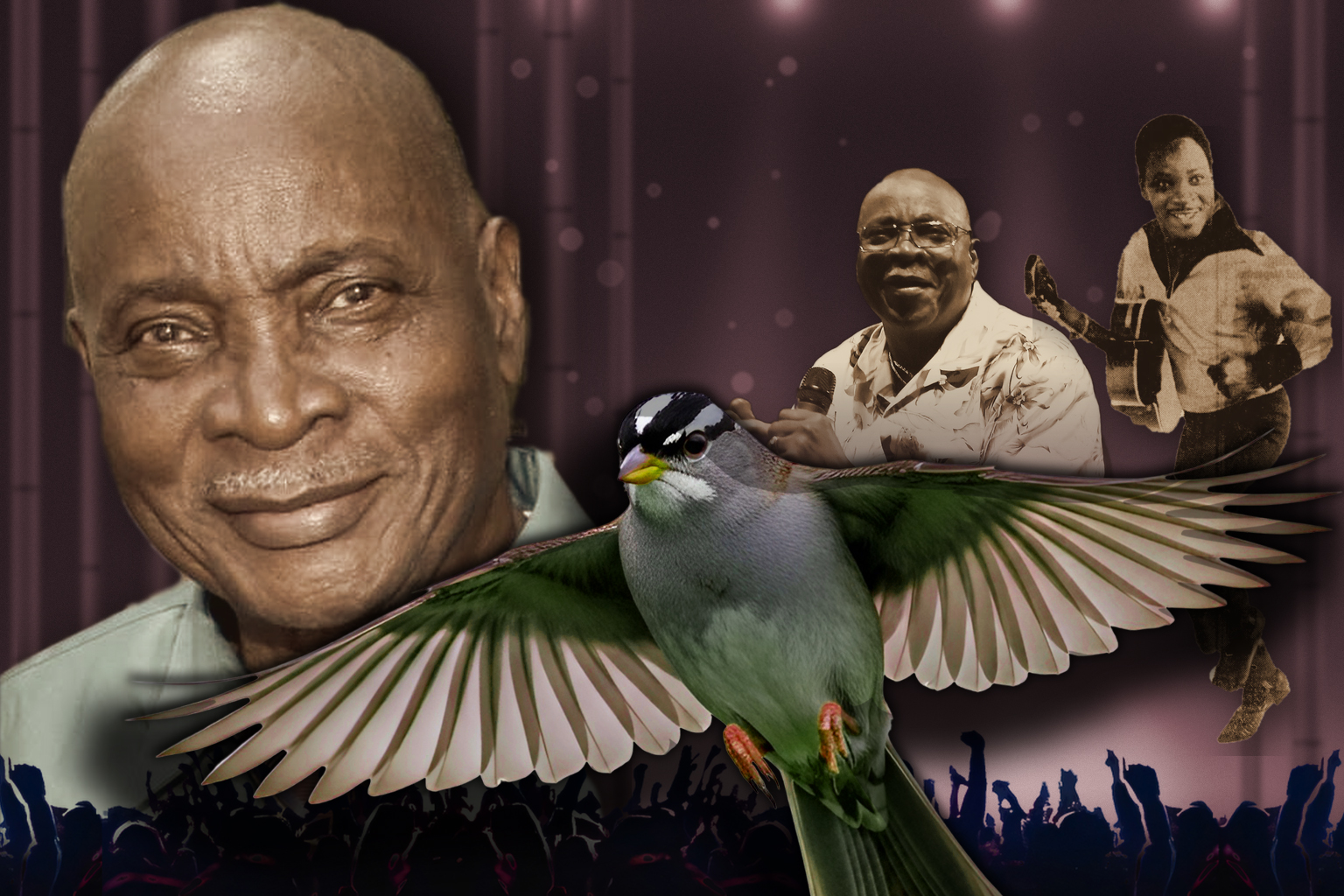
The news traveled quickly on Sunday, 27 September 2026, as the world was informed that Calypso music’s king, Mighty Sparrow, had died peacefully in New York after a brief illness. By the day’s end, tributes were arriving from Port of Spain and St. George’s, from Bridgetown, Kingston, Brooklyn, London and Lagos.
Barbados Prime Minister Mia Mottley said it most plainly: “Listen to his recordings and you hear our history.”[1] Trinidad and Tobago’s Prime Minister Kamla Persad-Bissessar titled her statement Goodbye to the Greatest and spoke of a man whose music had taught a nation to laugh at itself, think about itself, and take pride in itself.[2]
But it was Mottley’s sentence that stayed with us the most. It is the kind of line the late Professor Mĩcere Gĩthae Mũgo would have underlined twice. For her, the artist who carries a people’s memory in live performance, who argues and mocks and mourns in public on the community’s behalf, was never merely an entertainer. She called that work Orature, and she spent her entire career insisting it be taken as seriously as any library. Sparrow spent seventy years practicing this belief from the other side of the Atlantic.
Grenadian by birth, Trinidadian by boat
He was born Slinger Francisco on 9 July 1935 in Grand Roy, a fishing village on Grenada’s leeward coast. He was carried to Trinidad as a child when his father found work there as a carpenter. He grew up in Laventille, the hillside community above Port of Spain that also gave the world the steelpan, and he liked to describe himself as Grenadian by birth and Trinidadian by boat.[3] The joke has a whole regional history folded inside it: families moving between islands for work, small nations tied together by boats and kinship long before politicians drew up federations on paper.
The older calypsonians named him “Little Sparrow,” teasing him for hopping about the stage while every serious kaisonian stood still and sang. He kept the bird moniker, and the public soon replaced “Little” with “Mighty.” In 1956 his “Jean and Dinah” won him both the Calypso King crown and the Road March, the prize for the tune most played on the streets at Carnival.[4] Over the decades that followed he would write some 500 calypsos and record more than 70 albums.[5]
Grenada’s Prime Minister Dickon Mitchell compressed the whole arc into two sentences last week: “Grenada gave him his birthplace. Trinidad and Tobago nurtured his gift.”[6] Guyana, which he toured within months of his 1955 debut, claims him as well.[7] So does Brooklyn, where he led the Labor Day carnival as grand marshal, and so does Jamaica, Queens, where he made his home for decades.
The Chantwell’s Chair
To understand what Sparrow was, it helps to remember what calypso is and where it came from. The music was made by enslaved Africans in Trinidad. Its older name, Kaiso, is most often traced to the Hausa Kaito, a cry of approval close to “Bravo.”[8] The word began, in other words, as the audience talking back, and crowds in the calypso tents still shout it when a singer lands a line.[9]
The singer at the center of the early Kaiso bands was the Chantwell. Historians of the form trace that figure straight back to the West African griot. And Sparrow knew exactly whose chair he was sitting in. Calypso began by mocking the masters, he told The New York Times in 1992, and grew into “the mouthpiece for the underprivileged.”
In African Orature and Human Rights, Dr. Mũgo described orature as verbal art composed for communication that “culminates in performance,” and she argued that the orature artist in a healthy community is a defender of rights, the one who names the injustice and demands the restitution.[10] That description fit Sparrow perfectly. In his music, the composition is finished in public. The meaning is completed by a crowd that answers back. The subject is whatever the powerful would prefer nobody mention.
Dan is the man, and the lessons that stuck
In 1963, a year after Trinidad and Tobago gained independence, Sparrow won the Monarch crown, one of the major calypso competitions held during Carnival, with “Dan Is the Man in the Van,” a song stitched together from the nursery rhymes and primer sentences of the colonial West Indian Readers, schoolbooks whose illustrations showed white children in an English world.[11] The song is hilarious and it is devastating. Sparrow recites the fables he was made to memorize as a boy, then leaves the listener to work out what an education in someone else’s fairy tales was designed to produce.
Dr. Mũgo would have laughed hardest at that one, because she spent years fighting the same war with a different weapon. When she arrived in newly independent Zimbabwe, one of her first tasks was co-editing a set of supplementary readers for government schools, books that put African children’s own histories and landscapes in front of them. Sparrow sang the indictment; she was writing the remedy two decades later from across the ocean. And the problem has not gone away. At a moment when what children may learn about slavery and empire is again being fought over in public spheres and legislatures, “Dan is the Man in the Van” sounds less like a period piece than a warning.
The same is true across the catalog. His 1956 hit “Jean and Dinah” was a sly commentary on what, among other things, the withdrawal of American servicemen from their wartime bases in Trinidad and Tobago meant for a colony learning to see itself. It is hard to hear it now, given the country’s current geopolitical leanings, without wondering what verse the young Sparrow would have written. “Federation,” his 1962 Monarch winner, mourned the collapse of the West Indies Federation, and it echoes every time The Caribbean Community (CARICOM) argues again over free movement.
Omo Wale: the road back to Africa
If “Dan is the Man” is Sparrow’s critique of the colonial classroom, his 1963 masterpiece, “Slave”, is his act of remembering what that classroom left out. Sung in the first person by an African seized and carried across the Middle Passage to the West Indies, it is a vivid lament that does in a few minutes what whole curricula refused to do. Sparrow narrates how music and song was used by the enslaved as a vital survival and communication tool. “Slave” is also a reminder that physical freedom was merely the first step, as it detailed how life after emancipation wasn’t necessarily better. It was among what Rolling Stone rightly called his “vociferous anthems of racial defiance.”
The song traveled. Bob Marley is reported to have said it showed him what he wanted his own music to do. And in June 1990, months after walking out of prison, Nelson Mandela sat in Yankee Stadium while Sparrow sang “Slave” before him.
Thirteen years before that, Sparrow went to Lagos for FESTAC ’77, the Second World Black and African Festival of Arts and Culture, and toured West Africa. Among the thousands of artists in Lagos that season was Dr. Mũgo herself. And over the same weeks, the calypsonian and the playwright, each in their own tongue, put empire on trial. While in Nigeria, Sparrow was installed with an honorary Yoruba chieftaincy, Chief Omo Wale of Ikoyi. Omowale means, roughly, “the child has come home.” It is the same name Nigerian students gave Malcolm X at Ibadan in 1964.[12]
The Grenadian-born writer, educator and activist Professor Gus John, writing last week, placed Sparrow in the company he kept:
“In this sense, he was to Trinidad and Tobago and the entire Caribbean region, what Fela Kuti was to Nigeria and West Africa and what Bob Marley, Peter Tosh, Jimmy Cliff and others of their generation were to Jamaica and the world.”[13]
The Fela comparison deserves a second look. Both men made dance music that governments had to answer to. And both were loved for their bawdiness and feared for their tongues.
From the tent to the world’s dance floors
Calypso never stayed home. In the 1950s, the golden decade that made Sparrow, calypso records crossed to West Africa and found a natural cousin in highlife, the vibrant West African music genre that blends indigenous rhythms with jazz and brass instrumentation. Ghana’s E. T. Mensah and his Tempos band in Accra played calypsos alongside their highlife numbers, and Lord Kitchener, Sparrow’s great rival, sang for Ghana’s independence in 1957. Highlife fed the bands Fela came up through before he built Afrobeat, and highlife’s grandchildren now fill stadiums on every continent under the name Afrobeats. The rhythm that left West Africa in the holds of slave ships came back up the coast with added ingredients, and the continent danced to it.
At home, when young Trinidadians drifted toward reggae, soul and funk in the early 1970s, Lord Shorty answered with Soca, “the soul of calypso,” fusing kaiso with the rhythms of Indo-Trinidadian music. Sparrow did not sulk. Like Kitchener, he took up the new beat, its synthesizers and its soul-inflected drive, and kept delivering. Half a century on, Soca has come round to meet Africa directly. The circle that opened in the chantwell’s yard is closing on dance floors in Lagos, Accra, Port of Spain and Brooklyn, and Sparrow sits close to its center.
The whole man
An honest tribute must hold all of him. He was bawdy, gloriously and sometimes indefensibly. Much of the catalog rests on the double entendre, the calypsonian’s oldest tool, which allows a song to say two things at once and dares listeners to admit which one they heard. He rarely needed profanity; he trusted the crowd to finish the thought. That was the craft. It was also the alibi.
Nowhere was the tension sharper than in “Congo Man” (1964). On its surface the song borrows the lurid, ‘Dark Continent’, headlines of the Congo crisis: a cannibal, two white women travelling through Africa, a cooking pot. Listeners raised in the tents heard other songs underneath it, in a pun hiding in plain sight. It turned the oldest racist caricature of the African back on the empire that drew it. Yet the payback lands on the bodies of two women rather than on the colonial men who built the caricature, and the laughter is drawn from what is done to them. Authorities decided it was too much. The BBC kept “Congo Man” off the air for twenty-three years. At home, Trinidad’s own stations shut it out for longer.
The bans say as much about the censors as about the singer. Sparrow’s truths, sexual and political, were often more than official Trinidad wanted broadcast, and the double entendre was how he slipped them past the gate.
None of this excuses the misogyny, and the best Caribbean scholarship has never pretended it does. Of the 1964 hit, “Man Like to Feel,” the late Guyana-born scholar and critic of West Indian literature, Gordon Rohlehr, said no calypso gives “a clearer delineation of the patriarchal mind set,” as the sociologist Linden Lewis records in his study of calypso and masculinity.[14] Trinidadian scholar and writer, Professor Patricia Mohammed, complicated the charge without dismissing it. In the tribute lecture series If Sparrow Say So, she described the singer as a shapeshifter who never fully belongs to the men or women in his songs, and noted that “if he slurs women’s sexuality, he also castigates male behavior.” Her conclusion: the songs were used to shore up patriarchy, but neither they nor their singer were as simple as the critics claimed.[15]
Welcoming a new ancestor
Professor Gus John opened his tribute with the iroko, the great hardwood native to West African forests, fallen only to rise again among the elders and the faithful departed of the villages that raised them.[16] It is the right tree. Across much of the African continent, the dead are not gone. They join what the Kenyan theologian John Mbiti called the living-dead, the ancestors who stay present for as long as their names are spoken.[17]
Sparrow’s name will be spoken for a very long time. It will be spoken in carnivals across oceans. It will be spoken in classrooms where a teacher plays “Dan Is the Man in the Van” and asks the children what they are being taught, and why. It will be spoken in Accra, Lagos, and concerts worldwide wherever a Soca riddim meets a highlife guitar.
For years, Mĩcere Gĩthae Mũgo taught Caribbean women writers at Syracuse University, and she knew the tents’ lineage as part of her own. The two of them spent decades insisting, in different registers, that the voice of the people is itself a form of knowledge, and that the artist owes the community the truth. Utu, the humanist ethic at the heart of this Foundation, asks what we owe one another as human beings. Sparrow answered in song for seventy years: sometimes crudely, often brilliantly, always in public.
So, we pour libation for Sparrow. We say his name. We praise his storytelling. And we send up the oldest cheer the Calypso tents know, the one that crossed the water with the ancestors and never left.
Kaiso! Kaiso, Birdie. Fly home.
[1] “Regional Leaders Pay Tribute to the Mighty Sparrow,” Caribbean Today, 28 September 2026.
[2] “PM Persad-Bissessar Bids ‘Goodbye to The Greatest,’ Pays Tribute to Mighty Sparrow,” TTT News, 27 September 2026.
[3] Janine Mendes-Franco, “Bye-bye, Birdie: The Calypso King of the World dies at 91,” Global Voices, 28 September 2026.
[4] Peter Mason, “Mighty Sparrow obituary,” The Guardian, 28 September 2026; excerpted at Repeating Islands.
[5] “Tributes pour in for Mighty Sparrow… T&T, regional leaders among those honoring calypso icon,” CNC3, 27 September 2026.
[6] “Grenada mourns Mighty Sparrow; celebrates enduring Caribbean legacy,” CNC3, 28 September 2026.
[7] “Farewell to the Mighty Sparrow” (editorial), Kaieteur News, 29 September 2026.
[8] “Calypso,” National Library and Information System Authority (NALIS), Trinidad and Tobago, citing Errol Hill and Hollis Liverpool.
[9] “Soca & Calypso,” Notting Hill Carnival, 2024.
[10] Mĩcere Gĩthae Mũgo, African Orature and Human Rights (Institute of Southern African Studies, National University of Lesotho, 1991); definition as quoted in “Theory and Practice in African Orature,” Research in African Literatures (Project MUSE).
[11] Dennis Nichols, “Old School Education: Part 1 – Cutteridge and The Mighty Sparrow,” Kaieteur News, 15 June 2014; Dan Cloak, “Dan is the Man in the Van,” 28 October 2025; “Guest Editor’s Introduction: Resonance, Repetition, and Futurity Across the West Indian Archipelago,” American Music 42, no. 4 (2024).
[12] Malcolm X with Alex Haley, The Autobiography of Malcolm X (Grove Press, 1965).
[13] Professor Gus (Augustine) John, “‘The Songbird is Silent – but still sings sweetly!'” tribute, September 2026, shared with the Foundation.
[14] Linden Lewis, “Gender and Performativity: Calypso and the Culture of Masculinity,” The University of the West Indies, citing Gordon Rohlehr’s 1996 keynote address.
[15] Raymond Ramcharitar, “The Mighty Sparrow: Gender Warrior,” Trinidad and Tobago Guardian, reporting Patricia Mohammed’s lecture; see also Mohammed’s essay in Tout Moun: Caribbean Journal of Cultural Studies.
[16] Professor Gus (Augustine) John, “‘The Songbird is Silent – but still sings sweetly!'” tribute, September 2026, shared with the Foundation.
[17] John S. Mbiti, African Religions and Philosophy (Heinemann, 1969).