


“Orature, like all other works of art, is a part of the production process in society, with production
taking place at the intellectual and imaginative levels, culminating in performance.”1
-Mĩcere Gĩthae Mũgo
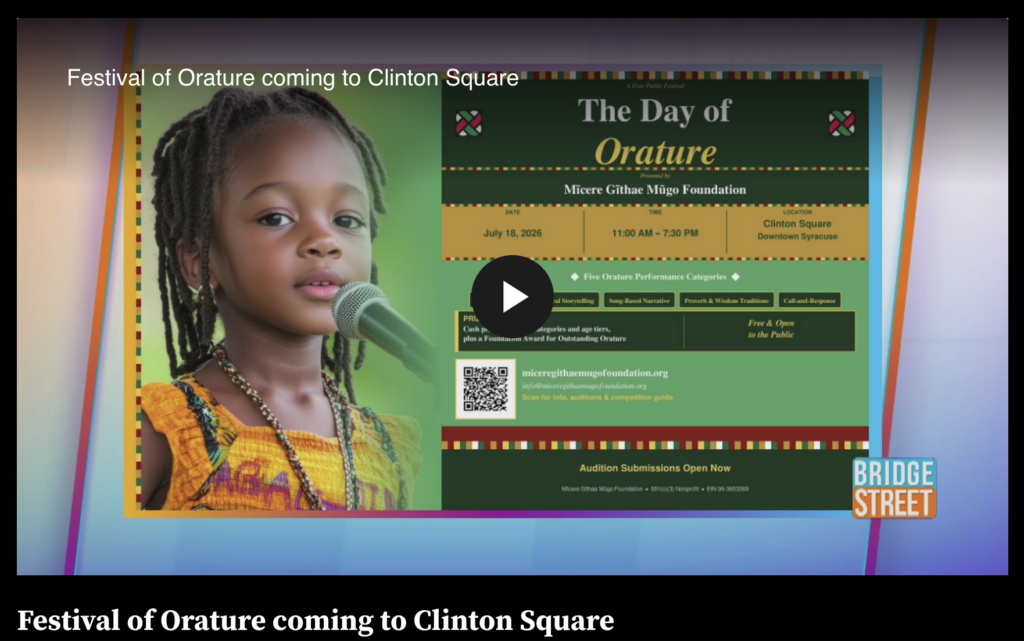
On Saturday, July 18, 2026, the Mĩcere Gĩthae Mũgo Foundation will present The Day of Orature — Central New York’s first-ever public festival dedicated to Orature in all its forms. Throughout the entire afternoon, Clinton Square in the heart of downtown Syracuse will become a stage built for inheritance. Young people aged six to eighteen, drawn from across the region, will step into the age-old tradition of standing before a community and giving it your voice.
The event is free and open to the public. It will feature a juried youth performance competition across five categories — Spoken Word Poetry, Oral Storytelling, Song-Based Narrative, Proverb & Wisdom Traditions, and Call-and-Response — with cash prizes across age tiers and a Foundation Award for Outstanding Orature. Guest performances will be woven throughout the day, and the festival will close with a formal awards ceremony.
Why This Moment Matters
Professor Mĩcere Gĩthae Mũgo passed from this world on June 30, 2023. We have set The Day of Orature to deliberately coincide with the third anniversary of her passing as an act of continuation.
She spent her life insisting — in her scholarship, her poetry, her activism, her teaching — that Orature is neither a relic nor a quaint tradition awaiting preservation. She once took to task the way Western Africanist scholarship had handled the dramatic traditions of the continent — singling out the influential study by Ruth Finnegan, still assigned in university classrooms across the world, including in Africa, for dismissing African drama as a minor and underdeveloped “phenomena,” worthy of a scant seventeen pages set against the hundreds devoted to poetry and prose.2 Professor Mũgo called this what it was: an imposed paradigm, a definition borrowed from outside the cultures it claimed to describe, applied with what she termed paternalism rather than rigor. She insisted, against that current, that African dramatic performance had flourished for centuries on its own terms, governed by its own aesthetics, deserving of its own seriousness.
That insistence was never narrowly academic. It was a claim about whose knowledge counts, and on whose authority a tradition gets to be called developed or undeveloped, art or artifact. Orature, she argued, is a living, breathing, transforming body of knowledge — one that carries history where history books exclude, and one that carries identity where identity is contested. She understood something the written word too often forgets: that the body telling the story is as much a part of its meaning as the story itself.
The Mĩcere Gĩthae Mũgo Foundation was born from the conviction that this worldview could not be allowed to recede simply because its author was no longer here to make the case herself. And so we incorporated. We built governance. We are establishing programs. We began, quietly and with purpose, the long institutional labor that precedes any public arrival.
The Day of Orature is that arrival.
On the Work That Brought Us Here
Building this Foundation from the ground has not always been graceful work. There have been moments of real uncertainty — about resources, about timing, about whether we could assemble, in time, what needed to be assembled. The logistics of mounting a free public festival — permitting, production, programming, outreach, fundraising — are humbling under the best of circumstances, and we have undertaken them without the cushion that more established institutions take for granted.
What has carried us forward is precisely what carries Orature forward across generations: the conviction that the story must be told, that the platform must be built, that the community must be invited to gather, even — especially — when the path to the gathering is not yet fully paved.
Along the way, we have learned that there are people across Central New York, across the diaspora, across the globe, ready to stand with us. People who knew Professor Mũgo. People who never met her but understand exactly what she stood for. People for whom Orature — as practice, as politics, as philosophy — is not abstract but personal: the griot grandmother, the spoken word stage at the community center, the proverb your father recited when you tried to leave the table too early.
This event is for all of you.
A Word to Those Beyond Syracuse
Many of you reading this are not in Central New York. You are in Nairobi, in London, in Toronto, in Accra, in Port-au-Prince, in Cape Town, in Stockholm, in Oakland, in Brooklyn. You have followed this Foundation from a distance, with warmth and patience, waiting to see what we would build with the trust you have extended to us.
Here is what we are asking of you now.
Share this. Forward this message. Post the press release. Tell your colleagues, your students, your networks, your communities. If you work in education, in cultural policy, in the arts, in philanthropy, this event belongs inside the conversations you are already having. Make the connection on our behalf.
Follow us. Track the festival at #TheDayofOrature across every platform, and help the world understand that what happens in Clinton Square on July 18th is not a local event with local significance — it is a local expression of something larger: the recognition that oral tradition is a living archive, one that belongs to every community that has ever organized its memory around the voice.
And if you are able to come to Syracuse on July 18th, come.
On Sponsorship and Support
We are not a well-endowed institution. We are a young Foundation executing an ambitious public event on the strength of our mission, our relationships, and the generosity of those who believe that culture is infrastructure.
We are actively seeking sponsors and donors — individuals and institutions whose values align with what we are building. Every dollar raised for The Day of Orature goes directly toward making the event possible: toward cash prizes for young performers, toward production costs, toward the outreach that brings this competition into schools, toward the professional programming that makes Clinton Square worthy of the tradition we are honoring.
If you know someone — a civic leader, a corporate social responsibility officer, a family foundation program officer, a community philanthropist — who should be in conversation with us, please make that introduction. We welcome every door that opens, and any amount that is offered.
What Comes After
We want to be clear about one thing: July 18th is not the destination. It is the beginning of an intentional journey we mean to make legible, in public, over time.
We are treating this event not only as a celebration of Orature but as an occasion to learn — to identify trends, to build archives, to add measurably to the discipline’s knowledge base. After the festival, we will aggregate what we have gathered and release it, along with formal impact reports, for anyone to examine. We will use this event to begin building the framework for the Prize for Orature as a standing program, and we will carry forward everything it teaches us into the planning of the next.
We are not building a stage for a single day and folding it away by nightfall. We are laying a foundation — in the most literal sense of the word — for something that should still be standing when the children who compete on July 18th are old enough to come back and judge.
That is the promise we are making to the City of Syracuse, to the memory of Professor Mũgo, and to all of you.
Join Us in Celebrating Young Voices
There is a reason public oral performance has been a feature of every human civilization across recorded history: the act of gathering — of being present, of listening together, of letting a young voice carry an old story into a new context — does something to a community that no other act can replicate. It reminds us that we are not isolated. That our stories are connected. That past and future are not separate things, but the same living current, moving through every voice willing to speak.
On July 18th, we will be extending a welcoming hand to everyone, young and old, in person and in spirit, to join us in celebration of young voices and the promise they hold.
Join us.
Notes:
- Mĩcere Gĩthae Mũgo, African Orature and Human Rights, Human and People’s Rights Monograph Series No. 13 (Roma, Lesotho: Institute of Southern African Studies, National University of Lesotho, 1991,9). ↩︎
- Mĩcere Gĩthae Mũgo, “Popular Paradigms and Conceptions: Orature-Based Community Theatre”, in Writing and Speaking from the Heart of My Mind: Selected Essays (Trenton, NJ: Africa World Press, 2012), 89–90. Mũgo’s critique engages Ruth Finnegan’s Oral Literature in Africa (Oxford: Clarendon Press, 1970, 500), and situates her argument alongside other scholarship affirming the depth of African dramatic tradition, including J.C. de Graft (1976), Olaudah Equiano (1987), Anthony Graham-White (1974), Frank M. Snowden (1978), Wole Soyinka (1976), and Bakary Traoré (1972). ↩︎