

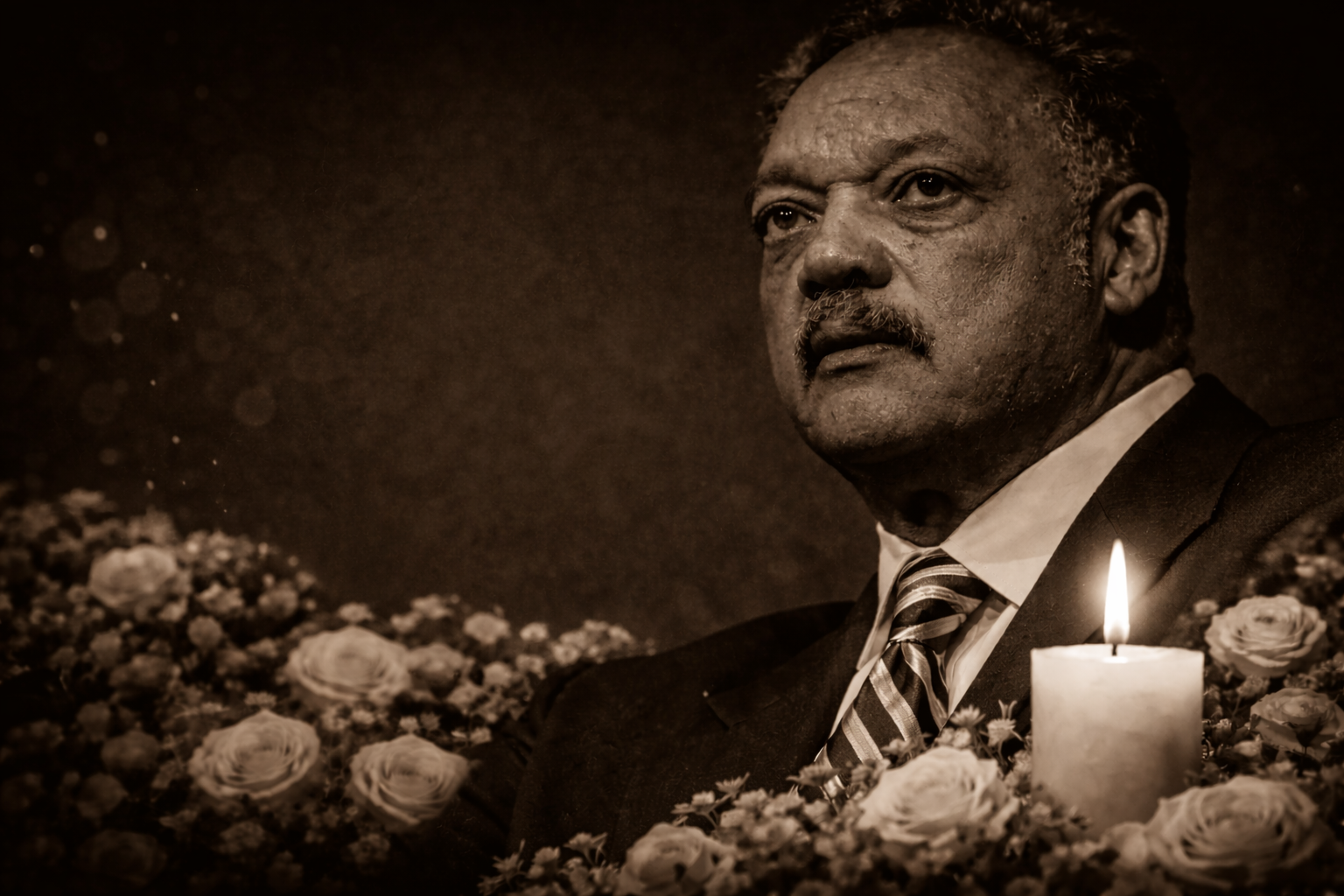
There is a particular quality of silence that descends when a great voice goes still. It is not the silence of absence alone, but the silence of everything that voice carried — every chant, every refrain, every call that rolled across geographies and into the souls of a people who had been told, in a hundred ways both brutal and bureaucratic, that they did not matter.
The Rev. Jesse Louis Jackson Sr., who died on February 17, 2026, at the age of 84, was that voice. And with his passing, a living thread connecting the civil rights movement’s most incandescent generation to our own has finally snapped. He was, as the African American Intellectual History Society noted in its tribute, “one of its major remaining ties to the Civil Rights era.” What follows is not merely an obituary. It is a reckoning with what he meant, what he built, where he went, and what we owe.
From Greenville’s Back of the Bus to the World’s Stage
Born Jesse Louis Burns on October 8, 1941, in Greenville, South Carolina, into an America that demanded he enter through the servants’ door of public life, Jackson took the long road by refusing to walk it. He rejected a minor league baseball contract to pursue education. He sat in at Greenville’s segregated lunch counters as one of the “Greenville Eight.” He marched from Selma to Montgomery alongside Dr. Martin Luther King Jr. in 1965. And when King was struck down on the balcony of Memphis’s Lorraine Motel — Jackson among the last to stand with him — he chose not to mourn in private but to inherit a mission.
His formation was theological and theatrical in equal measure. A student of orature before the term had found its modern theorists, Jackson grew up in the Black Baptist tradition, where the sermon is a living, breathing conversation between the preacher and the congregation, where call and response is not rhetorical flourish but communal covenant. He was an excellent student at the Chicago Theological Seminary who received a D in preaching — because, as his faculty adviser recalled, “That’s Jesse. He’s a very brilliant guy. But undisciplined.” He refused to write his sermons down. They lived inside him.
The Word as Weapon, the Voice as Liberation
Professor Mĩcere Gĩthae Mũgo, whose life’s work championed orature, recognized in Jesse Jackson a kindred tradition. Jackson’s speeches were not merely spoken; they were performed, embodied, inhabited. They carried the cadence of Scripture and the rhythm of the fields, the percussive logic of the Black church and the urgency of the picket line.
He was, as this tribute described him, “a poet and a wordsmith, a prolific and prophetic speaker, an inspirational orator and author of some of the most memorable and profound one-liners that elevated humanity.” His call-and-response phrases were not mere slogans. They were incantations. They conjured dignity where shame had been installed, possibility where foreclosure had been declared.
“My constituency is the desperate, the damned, the disinherited, the disrespected and the despised.”
— Rev. Jesse L. Jackson Sr., 1984 Democratic National Convention, San Francisco[1]
At the 1988 Democratic National Convention in Atlanta, his speech moved delegates to tears. He closed not with policy pronouncements but with a chant that would echo across campaigns for decades to come, including Barack Obama’s own:
“You must not surrender. You may or may not get there, but just know that you’re qualified and you hold on and hold out. We must never surrender. America will get better and better. Keep hope alive. Keep hope alive. Keep hope alive.”
— Rev. Jesse L. Jackson Sr., 1988 Democratic National Convention, Atlanta[2]
Jackson was beyond doubt among the most gifted orators of the twentieth century. A rare figure who understood that the oppressed cannot be freed by statistics alone but must first be freed in their own imagining of themselves. Jackson made people feel, and then he made them move. His voice was a gathering place.
A Continent Recognized, Not Forgotten: Jackson’s Africa
Jackson’s international legacy was the insistence that the Black American struggle was not a local grievance but a global one — indivisible from colonial exploitation, apartheid terror, and imperial double standards. He carried that conviction not merely in speeches but on airplanes, into state houses, across dusty border crossings, and into the volatile arena of frontline politics.
He first visited South Africa in 1979, two years after the state murder of Steve Biko. He condemned apartheid as “ungodly,” denouncing its government as a “terroristic dictatorship” — making, as the Washington Post reported at the time, “more of a stir among both blacks and whites than any American political figure to come here in many years.”
His anti-apartheid commitment ran deep for years. He entered the 1984 presidential race with the liberation struggle at the center of his foreign policy platform. He lobbied European countries to sever ties with Pretoria. He called on Harvard and other American universities to divest. He advocated for sanctions when the Reagan administration preferred “constructive engagement” — a euphemism, Jackson made plain, for complicity.
Then, in 1986, at the invitation of several African governments, Jackson led a delegation of activists, business representatives, and academics on a whirlwind eight-country tour of the continent, with particular emphasis on the Frontline States — those nations that bore the brunt of South Africa’s military and economic destabilization campaigns. He traveled through Nigeria, Angola, Botswana, the Democratic Republic of Congo, Mozambique, Tanzania, Zambia, and Zimbabwe. In each capital, he was received with state dinners, and enormous public gatherings. The focus, always, was to mobilize international opposition to apartheid.
“As a young civil rights activist, I knew how raw and ugly and violent the apartheid regime was. They were being jailed, we were being jailed. We were being killed, and they were being massacred.”
— Rev. Jesse L. Jackson Sr., The Guardian, December 2013[3]
He stood alongside ANC President Oliver Tambo on the steps of a protest in London, where some 150,000 people marched after Prime Minister Thatcher blocked substantive Commonwealth sanctions in November 1985.[4] His advocacy was credited with contributing to the passage of the U.S. Comprehensive Anti-Apartheid Act of 1986, one of the most significant legislative blows struck against the Pretoria regime.
When Nelson Mandela was released from Robben Island in February 1990, after twenty-seven years as a political prisoner, Jesse Jackson was there.[5] Not as a visitor nor spectator, but as a witness who had earned his place through years of agitation, solidarity, and sacrifice. And when Mandela stood at the pulpit of Jackson’s own Rainbow PUSH headquarters in Chicago, it was a homecoming of movements recognizing each other.
President Cyril Ramaphosa of South Africa, mourning Jackson’s death, did not mince words:
“We are deeply indebted to the energy, principled clarity and personal risk with which he supported our struggle and campaigned for freedom and equality in other parts of the world. Jesse Jackson devoted himself to the cause of justice as a human endeavor without borders.”
— President Cyril Ramaphosa of South Africa, February 17, 2026[6]
Jackson returned to Africa in the late 1990s as an envoy for President Bill Clinton, working to intervene in conflicts in the Democratic Republic of Congo, Sierra Leone, and Nigeria. His engagement with the continent was always relational. He understood that solidarity is not a speech act; it is a personal practice maintained over time.
The Caribbean and Beyond: Solidarity Across Seas
Jackson’s Pan-African solidarity extended naturally to the Caribbean, where the histories of slavery, colonialism, and resistance were not distant relatives of the American civil rights struggle but its blood kin. He visited Haiti on multiple occasions, drawing international attention to its worsening food crisis and the structural violence of U.S. trade policies that had flooded the market with subsidized American rice, driving Haitian farmers from their land and dismantling the agricultural foundations of what had once been a self-reliant nation.
In a 2008 NPR interview recounting a recent mission to Haiti, Jackson situates the country’s plight within its singular historical significance: “Haiti in our vision is the creditor and we are the debtor, or we would all be speaking French today, had not Toussaint L’Ouverture defeated Napoleon.”
In Cuba, as across Latin America and the Global South, he was regarded as a principled voice for self-determination — one of the very few American political figures who treated Caribbean and Latin American sovereignty as worthy of respect rather than management.
Beyond Africa and the Western Hemisphere, he was admired as a voice for the oppressed, linking Black American struggles to colonial and neo-colonial exploitation. In 1979, defying the U.S. policy of non-engagement with Palestinian leadership, Jesse Jackson was received by an honor guard at the PLO Headquarters in Beirut. There, Yasser Arafat embraced him, calling him “my friend and the friend of justice and humanity.”
A People Named: The Weight of ‘African American’
Language is never neutral. Every name that power assigns to the dispossessed carries within it a theory of their diminishment. Negro. Colored. Black. Each term has its own history, its own politics, its own freight of dignity or degradation.
In the late 1980s, joining calls by NAACP members and other movement leaders, Jackson championed the widespread adoption of the term “African American” to replace “Black American” — not as an erasure of Blackness, but as an assertion of ancestral origin, historical rootedness, and the kind of cultural integrity that every other ethnic group in America was permitted to claim. He stated his reasoning with clarity:
The significance of this intervention is easy to underestimate in retrospect, so thoroughly has the term entered common usage. But consider what it accomplished: it insisted that people whose ancestors had been systematically stripped of their names, their languages, their genealogies, their continents, and their identities were nonetheless people with a place of origin — not a color, not a legal category, but a geography, a history, a civilization.
In this, Jackson echoed one of the core commitments of Professor Mĩcere Gĩthae Mũgo herself — that to name oneself on one’s own terms, in the full acknowledgment of one’s heritage, is an act of decolonization. The term African American is imperfect, as all terms are, and debate continues about its scope and its relationship to the broader African diaspora. But its adoption was a moment in which a people reached across the Atlantic and claimed their birthright.
The Last Bridge: What His Passing Means
The civil rights generation was a generation of giants. But giants, too, are mortal. In the decades since the assassination of Dr. King, each passing — of Coretta Scott King, of John Lewis, of C.T. Vivian, of Joseph Lowery — has narrowed the living connection between the movement’s foundational struggles and our own. Jesse Jackson was the last of that generation to have walked beside King, to have been dispatched by King, to have been shaped in the heat of the movement’s most transformative years and then carried that formation across six more decades of unceasing work.
He was, as Bernice King observed upon his passing, “a gifted negotiator and a courageous bridge-builder, serving humanity by bringing calm into tense rooms and creating pathways where none existed.”[7] And he was something more than that: he was the human tissue connecting the moral clarity of the 1960s to the political messiness of the decades that followed. He could stand in 1968 with blood on his shirt — literally, having been present at King’s assassination — and then stand in 2024 at the Democratic National Convention, still calling the generations to account.
That bridge is now gone. And what should concern us is not only what we have lost, but what is now required of us. For the adversaries Jackson and others spent their lives confronting have not retired in kind. Those forces have not grown less powerful with the passing of the generation that named and challenged them. They have, if anything, grown more sophisticated, more embedded, more capable.
The global solidarity Jackson summoned — the solidarity that brought him to Soweto and Harare and Kingston and Havana — is more urgently needed today. At a moment when the rights and dignities of Black and Brown peoples are under assault across multiple continents, when international institutions are being dismantled or corrupted, when authoritarianism dresses itself in the language of freedom, the Pan-African vision that Jackson embodied is not a romantic inheritance but a living necessity.
We who come after must now do more than mourn. We must study. We must organize. We must travel and speak and listen and build. We must carry the commitments of our departed elders into encounters with adversaries those elders could not have entirely anticipated. The tools must be retooled. But the struggle is the same struggle. And the solidarity must be the same solidarity — rooted, as Jackson insisted from Soweto to the South Side of Chicago, in the knowledge that what happens to any one of us happens to all of us.
Farewell, Reverend
Jesse Jackson was not a saint. He was a man of extraordinary gifts and genuine contradictions. And it is precisely in his full humanity — in the complexity of a long life entirely given to the work of justice — that his example is most instructive.
He knew, as all serious freedom fighters know, that the work does not end with one’s own generation. He lived long enough to see the arc bend toward a Black president in the White House and then bend back again. He lived long enough to see the gains of the Voting Rights Act gutted. He lived long enough to see children in American cages and apartheid walls rising again under different names. And he kept going.
Now it is we who must keep going. The Mĩcere Gĩthae Mũgo Foundation has spent the past few days reflecting on Jesse Jackson’s legacy alongside mourning a kindred spirit, a comrade-in-struggle across oceans, a man who understood — as our own Mwalimu understood — that justice is not a destination but a practice. That it must be performed, again and again, in the body, in the voice, in the choosing of which side of the line one stands on.
As the Rev. Jesse Jackson is laid to rest this week, we heed that call. And as we do, we hear the echo of his voice, rising again in the cadences he made his own, in the chant he would not let us abandon:
I am… somebody
I am… somebody
I am… somebody
[1] Rev. Jesse L. Jackson Sr., Address to the 1984 Democratic National Convention, San Francisco. Cited in: Washington Post / AP, “Key quotes from the Rev. Jesse Jackson,” February 2026.
[2] Rev. Jesse L. Jackson Sr., “Keep Hope Alive” Address, 1988 Democratic National Convention, Atlanta. Published in full at Amistad Resource, amistadresource.org; quoted in Troy Record, February 2026.
[3] Rev. Jesse L. Jackson Sr., The Guardian (Opinion), December 8, 2013. https://www.theguardian.com/commentisfree/2013/dec/08/jesse-jackson-on-meeting-mandela
[4] Anti-Apartheid Movement Archives, “History of The Anti-Apartheid Movement in the 1980s,” citing the London march of November 2, 1985. https://www.aamarchives.org/history/1980s.html
[5] Wikipedia / multiple sources: “Jackson accompanied Nelson Mandela on Mandela’s release from prison in South Africa.” See also: Presidential Archive of South Africa, “Reverend Jesse Louis Jackson,” https://www.presidency.gov.za/reverend-jesse-louis-jackson
[6] AllAfrica.com, “South Africa: President Ramaphosa Pays Tribute to Reverend Jesse Jackson Sr,” February 18, 2026. https://allafrica.com/stories/202602180371.html
[7] Bernice King, post on X (Twitter), February 17, 2026. Cited in NBC News, “Rev. Jesse Jackson’s death prompts outpouring of tributes and praise.” https://www.nbcnews.com/news/us-news/death-rev-jesse-jackson-prompts-outpouring-tributes-praise-rcna259325